

You pay CHF 100 in Switzerland with your Italian card and no “fee” appears in your banking app. Does that mean the currency exchange did not cost you anything?
If the account linked to the card is in euros and the payment is made in Swiss francs, an EUR/CHF conversion has to take place somewhere. To understand how much you actually paid, you need to know who performs the conversion, which exchange rate is applied, and whether any additional fees are charged.
What happens when your card and the payment use two different currencies
Imagine you have an Italian account in EUR and use your card to pay for a CHF 50 lunch in Lugano.
The merchant receives Swiss francs, while your account is in euros. If you do not already have a CHF balance linked to the card, the amount therefore needs to be converted.
If you pay in CHF, the conversion is handled according to the conditions of the card network and the financial institution that issued your card. Any currency conversion fees depend on the bank and the product you use: Mastercard itself recommends checking them directly with your card issuer.
This means that two Italian cards used for the same purchase in Switzerland may be subject to different conditions.
Does “I don’t see any fees” mean the exchange is free?
No. The cost of a payment in a foreign currency can appear in different ways. There may be an explicit fee charged by the issuer, or the final amount may depend on the exchange rate used and any markup included in the card’s terms and conditions.
This is why simply checking your bank statement for the word “fee” is not enough. Visa rules, for example, require issuers to disclose any fees on international transactions and currency conversion, as well as the mechanism used to determine the exchange rate.
To understand the actual cost, you can check a few things:
| What to check | Where to look |
| Original amount | Receipt or transaction in CHF |
| Amount charged | Banking app or bank statement |
| Exchange rate applied | Transaction details or card terms and conditions |
| Currency conversion fees | Fee schedule or card pricing terms |
| Any DCC | POS screen and receipt |
The POS asks you to choose EUR or CHF: what changes?
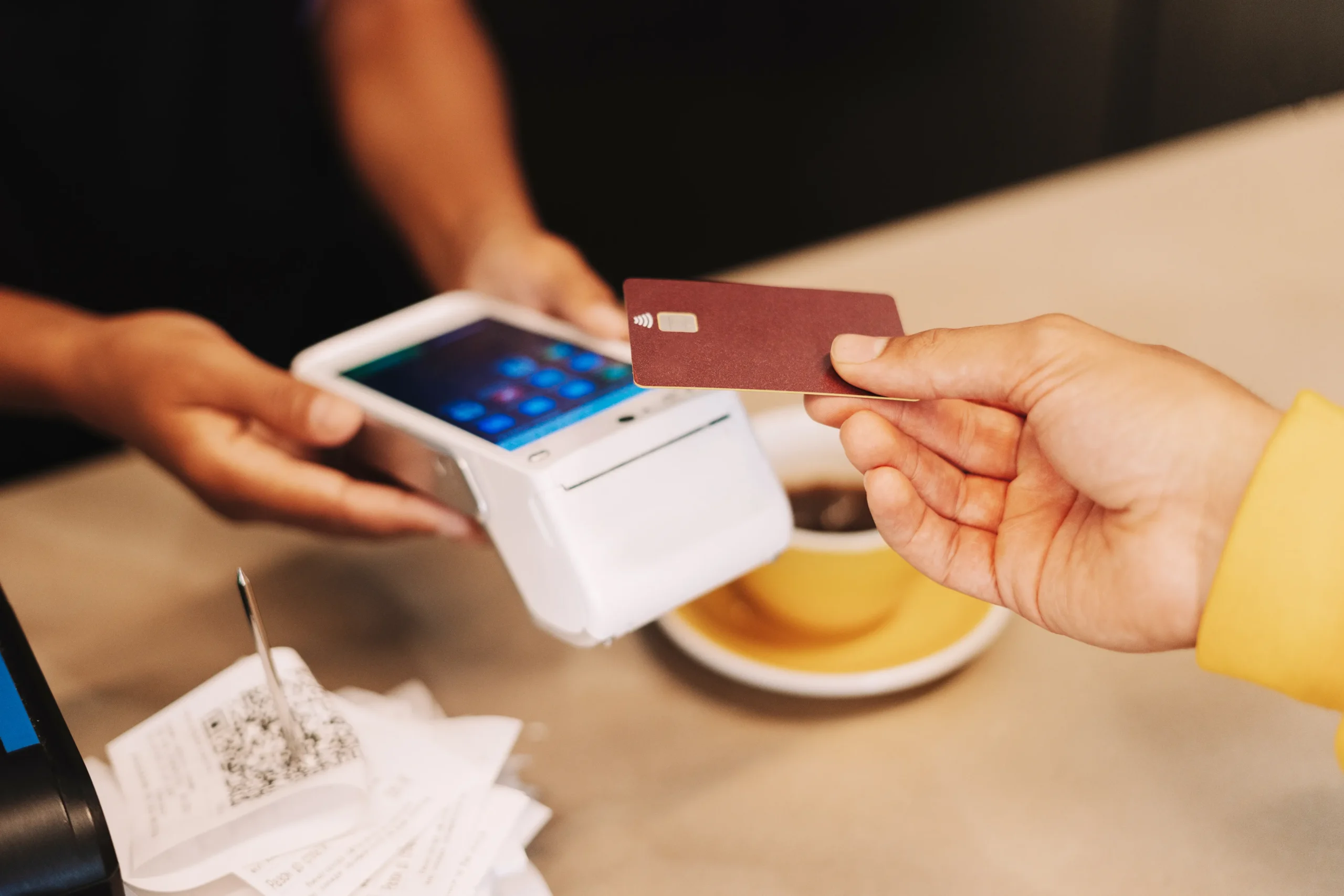
When making a payment in Switzerland, you may see a choice like this on the terminal:
CHF 50
or
XX EUR
The option to pay directly in the currency of your card is called Dynamic Currency Conversion (DCC).
If you choose EUR, the conversion is carried out by the DCC service used by the merchant or its acquirer. If you choose CHF, on the other hand, you make the payment in the local currency and any conversion is handled afterwards according to the conditions of your card. Mastercard describes exactly this distinction between conversion carried out by the acquirer through DCC and conversion carried out by the issuer when the local currency is selected.
With DCC, the amount in both currencies, the exchange rate applied, and any fees or markups must be displayed.
Seeing the price immediately in euros may seem simpler, but it does not automatically mean you are getting a more favourable exchange rate. Visa notes that DCC may include a markup, while Mastercard recommends leaving the conversion to your own bank and declining the currency conversion option offered by the merchant.
However, this does not mean that paying in CHF is always free: your bank may still charge fees for transactions in a foreign currency.
Case 1: you live in Italy and pay in Switzerland with a card in EUR
This is the simplest case.
Your account is in euros, you spend a day in Switzerland, and you pay for a hotel, restaurant, or purchases in CHF.
Before deciding whether your card is convenient, check three things:
- whether your bank charges a fee for foreign currency payments;
- which EUR/CHF exchange rate is used;
- whether you paid in CHF at the POS or accepted a conversion into EUR.
If you do not see a separate fee, compare the CHF amount of the purchase with the EUR amount actually charged. This is the most practical way to understand the result of the conversion.
Case 2: you live in Switzerland and pay in Italy with a card in CHF
The mechanism is the same in reverse.
The price is in EUR, but the account linked to the card is in CHF. If you pay in euros, the conversion takes place according to the card’s conditions; if the POS offers to charge you directly in CHF through DCC, the exchange rate is instead determined by the service carrying out that conversion.
Here too, seeing your own currency displayed on the POS does not in itself mean that the option is more convenient.
Is it better to exchange in advance or let the card convert at the time of payment?
It mainly depends on how much you spend, your card’s conditions, and whether you can actually use the currency you have purchased.
Letting the card convert at the time of payment is convenient: you do not have to plan in advance how much you will spend. But to assess the cost, you need to know the conditions applied to foreign currency transactions.
Exchanging in advance, on the other hand, lets you know the rate and the amount received beforehand. However, this is only useful if you have an account or balance in the destination currency that you can then use to make the payment.
This is particularly important if you live in Italy: if you only have an account in EUR and a card linked to that account, converting EUR into CHF in advance through an external service is not enough. You also need a personal account in CHF where you can receive the francs, as well as a card or another tool that allows you to spend them.
Where Swimo fits in
Swimo is not a payment card, and its vIBAN is not an account to use for purchases. It is a service dedicated to currency exchange and works through bank transfers.
For occasional transactions, Traditional Exchange allows you to convert EUR, CHF, USD, and GBP: you submit a request, lock in the rate, and after making the bank transfer, you receive the converted currency in your personal destination account.
This can be useful, for example, if you already have a CHF account that you can use for your expenses and want to compare the cost of converting in advance with the rate applied by your card during individual purchases.
If, on the other hand, you only have a card in EUR, Swimo does not replace the payment function of the card: currency exchange and payment remain two separate operations.
Before paying in a currency different from your own
When you use an Italian card in Switzerland, or a Swiss card in Italy, do not stop at whether or not you can see an explicit fee.
Check which currency you are paying in, who performs the conversion, the exchange rate used, any fees charged by the card, and the final amount debited.
This comparison, rather than the single “fee” line item, tells you how much the currency exchange actually cost you.
Frequently asked questions
In Switzerland, is it better to pay in CHF or EUR?
If the POS offers conversion into EUR through DCC, paying in CHF allows you to avoid the exchange rate proposed by the DCC service and leave the conversion to your card network/issuer. You should still check whether your bank charges any fees for foreign currency payments.
Can I pay a fee even if I do not see it on my bank statement?
The cost of the conversion may not appear as a separate line item. To assess the transaction, you need to check both any issuer fees and the exchange rate actually applied.
What happens if I choose EUR on a POS in Switzerland?
If Dynamic Currency Conversion is being used, the merchant or its provider converts the price from CHF into the currency of your card using the exchange rate shown on the terminal. You should also be able to see any markups or fees before accepting.
Is it worth exchanging EUR into CHF before going to Switzerland?
It depends on your card’s conditions and the exchange rate available through an advance conversion. In addition, to spend the CHF you have already converted, you need an account or CHF balance that can be used for payments.
Can I pay directly with Swimo?
No. Swimo is a currency exchange service and works through bank transfers. The vIBAN is a technical transit account and cannot be used to make purchases or payments directly.